Impressive, chilling and just a little bit silly: this update of Frederick Forsyth’s classic about a ruthless killing machine makes for highly enjoyable, trigger-happy viewing
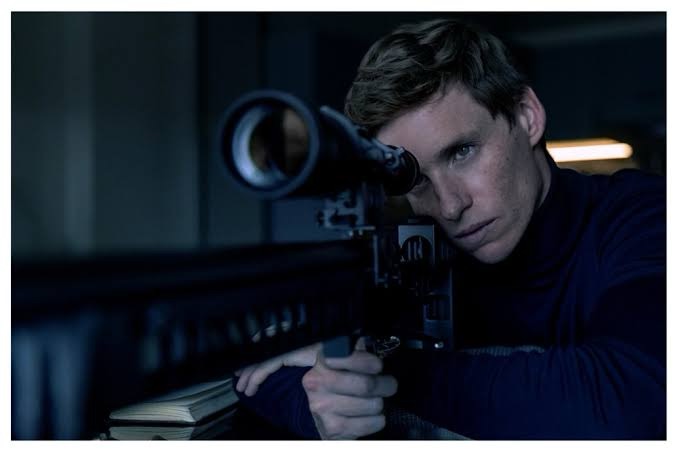
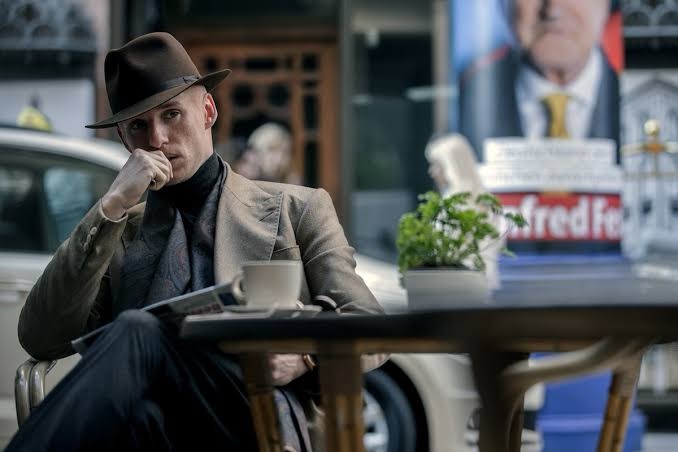
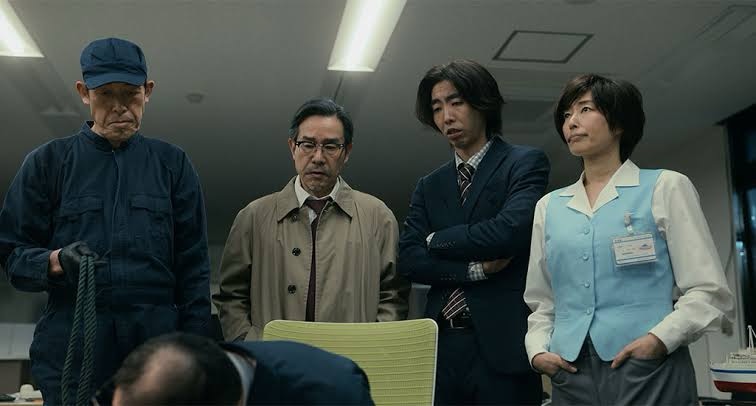
For the first few minutes of The Day of the Jackal, you wonder why they have bothered to pay the Oscar winner Eddie Redmayne at all. He is so well disguised as an older German man that it could be anybody buried under all those prosthetics. Yet soon enough, after much prancing around an office building – where he shoots anyone who gets in the way – we are finally treated to the unboxing of Redmayne, as he peels away the mask, the wig, the makeup and the contact lenses. The scene is impressive, chilling and just a little bit silly – a neat summary of how the drama itself will unfold.
This is an update of Frederick Forsyth’s 1971 novel, thrust into the modern world of international politics, espionage, the dark web and criminal underworlds. Redmayne is the Jackal, a shapeshifting assassin so competent he can accurately fire a sniper rifle and hit his target from a record-breaking distance – so far away that, at first, MI6 refuses to believe that it is possible. He is a ruthless killing machine, sparing no thought for the collateral damage to the passersby who happen to be in the wrong place at the wrong time. And yet, in this version, he is also a family man, keeping a big assassin-shaped secret from his wife and son. If the Jackal is typically elusive, this detail aims to flesh him out and make him more human.
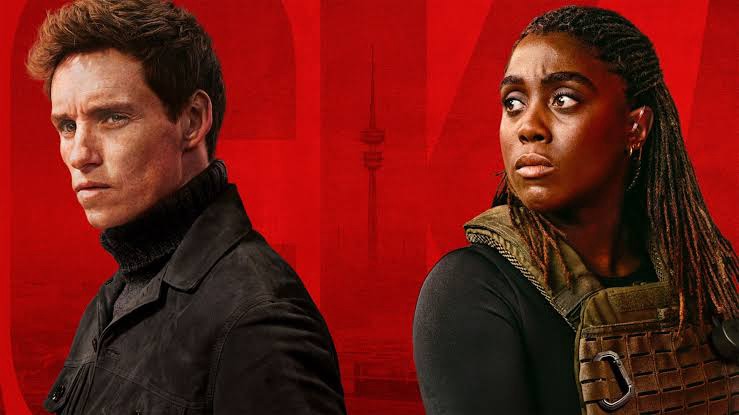
We first meet the Jackal in Munich, where he has been hired to take out a divisive populist politician, an act that has potentially international ramifications. The case attracts the interest of British intelligence, in particular Lashana Lynch’s Bianca, a gun expert with a hunch about this new supersniper. “Snipers are my patch,” she says, as she muscles in on the investigation. This whole show is a gun-lover’s paradise, as characters salivate over firearms models, innovations and techniques. The Jackal is good at disguises and puzzling his way out of seemingly impossible traps, but he is best at shooting people squarely in the head with powerful weapons.
It turns into an inevitable cat-and-mouse scenario, with the roles constantly shifting, and both Bianca and the Jackal leaving a trail of destruction in their bid to outfox the other.
But it takes its time to get there. The first five instalments of the 10-episode run are being released in one go, and watching them in a single sitting leaves an impression that it is a little overstuffed with parts that are destined to interlock at some point – if only the Jackal could take a break from hopping around various glamorous locations, where he must tie up a surprising number of loose ends.
There is a loyalist paramilitary storyline and a billionaire tech bro turned philanthropist who is threatening to expose the financial networks that run the world. There are also parallel family issues, as Bianca and the Jackal’s lines of work interrupt their ability to parent without the worry of getting shot every time they go into the office. The family dynamics slow it down and feel oddly tacked on to an otherwise energetic thriller.
The opening episode is excellent: it promises a taut, lean drama that makes the most out of its acting talent and lays the foundations for a whole lot of well‑executed action. Watching the Jackal carry out his assignments and get away with his audacious plans – despite terrible odds to the contrary – is genuinely exciting. Even though you know he is probably not going to get caught, every checkpoint has you holding your breath, just in case he messes up.But it eases off as it goes along and starts to take on the afflictions of most prestige TV right now. It is too long, overly reliant on showy changes of location – look, he is in Estonia/Sweden/Germany/Spain – and abandons the precision of the first episode in favour of complicating every scenario. Ultimately, in the first half of the season, that means we aren’t really given enough time with either the Jackal or Bianca to fully invest in their sides of the story.
When it comes to Korean dramas, romantic stories have always been reigning. Recently though, we’ve seen success from darker storylines, or at least, those who aim to look outside of the box. You know, like Squid Game. And now, Korean reality shows are also taking the world by storm. So, what do you get when you mix something like Squid Game and reality shows? Well, maybe The 8 Show, the newest offering from Netflix.
The 8 Show on Netflix is a mix of entertainment and violence. Sounds familiar? It’s a formula that creators have been trying to squeeze dry and see what sticks with the audience post-Squid Game.Ironically, it’s similar to what The 8 Show depicts. You also have director Han Jae-rim from movies such as Emergency Declaration and The Face Reader leading the way, making his debut into drama territory. Read our review to find out if you should stream or skip The 8 Show on Netflix.
Most will draw comparisons between The 8 Show and Netflix’s other series, Squid Game. I am perhaps in the minority, of the people who have yet to see the global phenomenon. So, I suppose that comes with merits because I’m immune—or oblivious rather—to the comparisons. I can see why the likeness — both shows have a similar premise with contestants vying for prize money. But beyond the obvious, both provide critiques on social class, wealth disparity, and inequality.
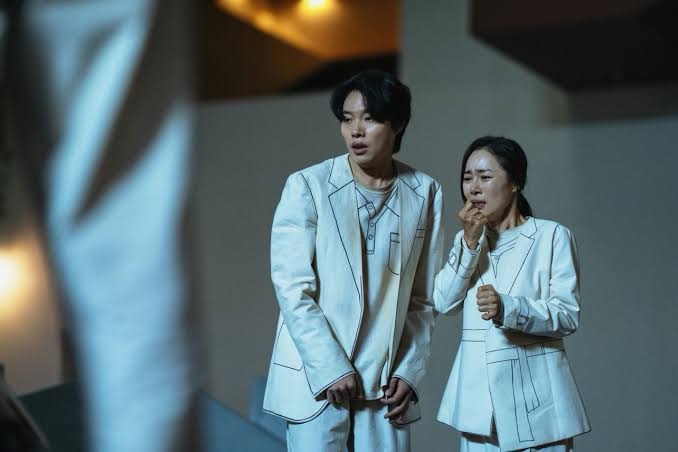
If anything, The 8 Show feels reminiscent of something closer to reality, that of comedian Tomoaki Hamatsu, also known as Nasubi. For 15 months, millions of viewers watched him live in total isolation for a Japanese reality show. At some point, Bae Jin-su or Third Floor (played by Ryu Jun-yeol) even looked eerily similar to the comedian. If the series wasn’t based on the webtoons Money Game and Pie Game, I’d be sure that the showrunners drew inspiration from that real-life event.
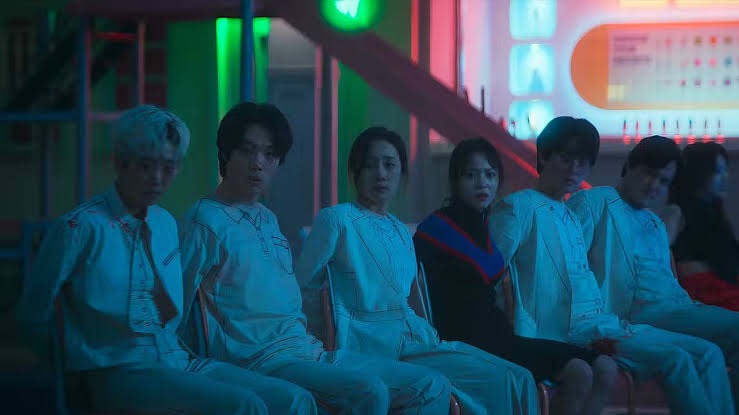
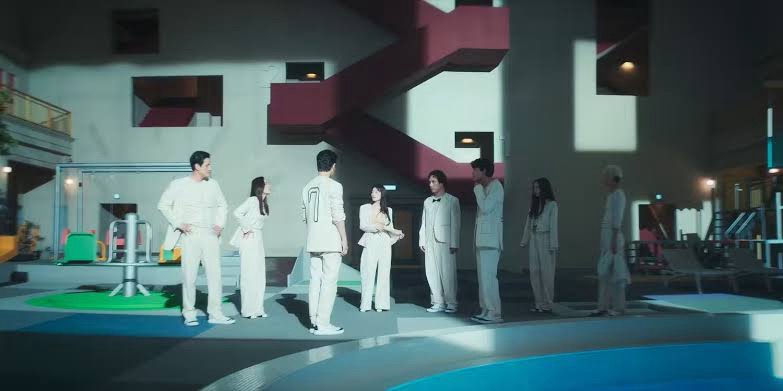
But choosing to showcase reality is one of The 8 Show’s biggest draws. Each character—named after the floors they reside in—somehow represents an individual in a society. First Floor (Bae Sung-woo) is that hardworking father, the breadwinner who wants to provide for the family despite his physical disability. Second Floor (Lee Joo-young) is the classic tough-on-the-outside but a softie who wants to help others. Fourth Floor (Lee Yul-em) represents ambitious individuals who strive to climb the social ladder no matter how difficult. And so on… but even more so, they are a mirror to society, essentially how society must function and the roles an individual takes. After all, the show itself is a microcosm of society.
Fifth floor (Moon Jeong-hee) takes on the role of the carer while Sixth Floor (Park Hae-joon) is the troublemaker. Seventh Floor, represented by clean looks and glasses, is the brain of the group while Eight Floor (Chun Woo-hee) is the rebel, the one who defies the rules. And you have Third Floor, our lead character, our regular minimum-wage worker who wants to succeed in life. He represents the average Joe, just either you or me. What happens then, if you put all these individuals in an enclosed space? Will they survive or fall apart? It’s almost like Lord of the Flies. But set in Hunger Games and Battle Royale style with the Squid Game prize money aspect along with the social divide that was apparent in Snowpriercer.
Despite their differences, they all have the same goal of gaining riches beyond their imagination and that makes for compulsive watching. Audiences can put themselves into their shoes, making them avatars of sorts on how they think they would act if they were put on the show. It helps even, that they are nameless. We have some glimpses of their lives outside of the show, but we’re not told more, keeping us in the dark.
A worthy but futile attempt to keep viewers invested
Some may think that stripping the characters of their identities makes them one-dimensional and nothing but stereotypes. But perhaps that is the point. We’re not meant to root for anyone as anyone can be just as evil if pushed to their limit with no way out. If their heart is in the right place but their actions say otherwise, are they bad or good? We’re left to ponder. The second half of the series could have spent more time exploring these complex characteristics rather than going off the rails to something simply fantastical. It moves away from being a mirror of society to something that feels too bizarre to be true.
The 8 Show is at its most compelling when it sticks to its initial premise: a reality show. Some of the most gripping moments are when we see the characters strategising or conspiring. It’s not only because it can be spicy or juicy. But because it’s a reflection of how we function as a society. Plus, aren’t those moments the best in reality shows? We are meant to be entertained, not disgusted or bored.
Furthermore, the second half fell prey to its characters’ fear: violence. The onslaught of violence feels repetitive, and you start to be that horrified viewer who just wants it all to end. Or worse, bored. What is the point of the never-ending depiction of it, if we already know what it’s trying to say? Just more shock factor, perhaps? It did not earn extra points on my card.
The 8 Show also has a lot of numbers and mathematical sequences. And to help viewers better understand, they show the rules in written form and explain a bit. But that too only appears conveniently without any consistency. There are hidden “rules” that they discover but they come and go. In addition, there are attempts to be humorous and while I did find myself laughing at times, especially during the talent show, the unserious tone when things start to get serious is very off and jarring.
There have been survival death game shows and movies like this. The 8 Show follows the pattern to a certain degree. But to also stand out, it tries to deviate but not fully. Then, it just ends up falling into cliches that serve no purpose. It would also be fine not to rush the sequence so suddenly into chaos. But then, the pacing takes its sweet time for nothing to happen and then rushes things from episode six. From then on, it is the same thing over and over until the eighth episode. Because of course, The 8 Show with eight players and eight floors has to end with eight episodes. The result? The last few episodes drag their feet, repeating similar things, mostly cycles of violence. I felt like a contestant stuck on the show…
There have been plenty of narratives that critique capitalism and inequality in South Korea and beyond: Squid Game, Parasite, and even Snowpricer to a global extent… the list goes on. So, if you’ve consumed plenty of similar content, you know what they have to say. But what else do they have to show? Ironically, stories about capitalism capitalise on them so much, they feel almost redundant. That’s not to say we should be immune to the very real issues that are happening. It’s more of, what could be done? Parasite showed the reality of those living in basement homes and in fact, they are now being phased out due to the dangers of flooding.
What about The 8 Show on Netflix? What does it mean for us as an audience? Is it simply something entertaining to watch? What new does it offer? I’m afraid, nothing much. Despite the strong performances from its lead cast, much is left to be desired. There is a worthy attempt to showcase the disparity that we experience in society but going beyond that, the effort feels futile. But maybe if you watch long enough, you’ll feel entertained…
The Penguin: A Gritty Take on Gotham’s Underdog Villain
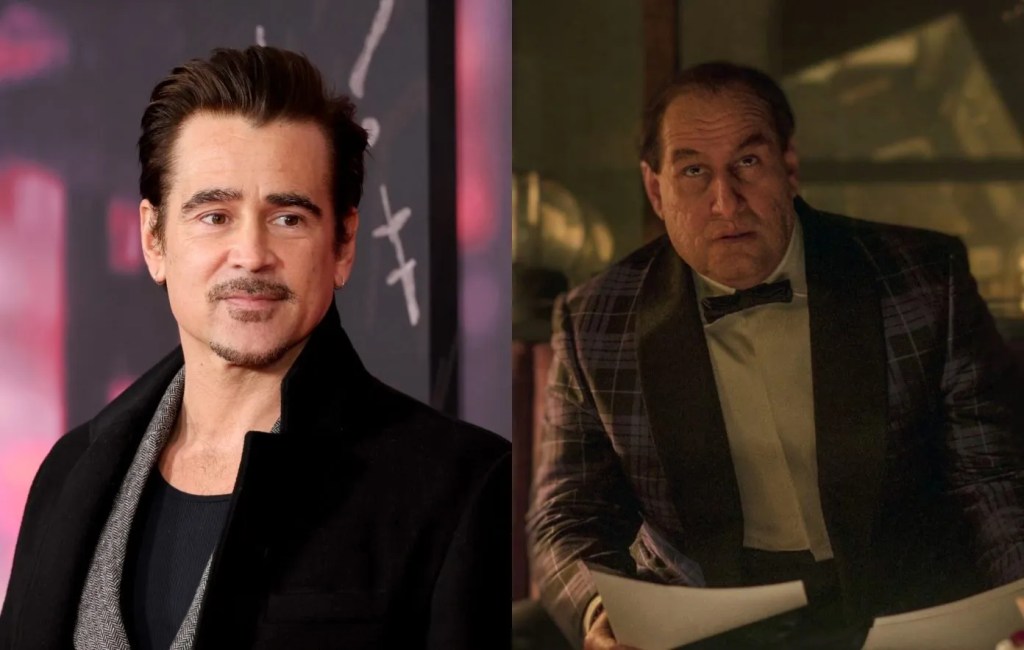
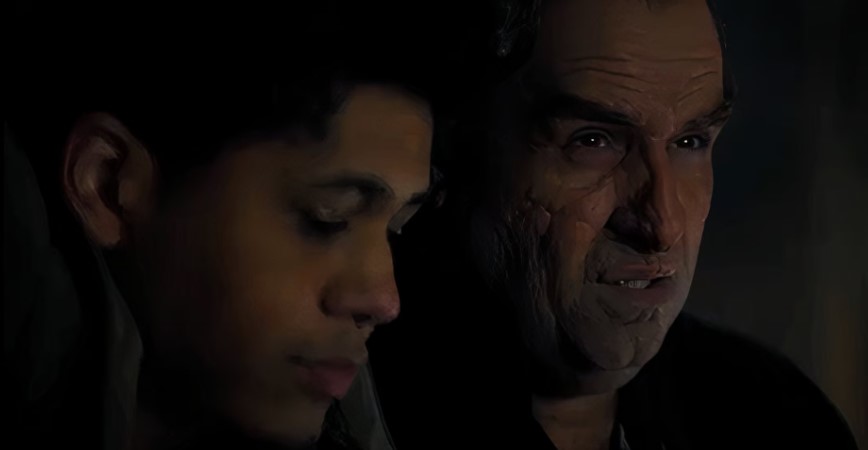
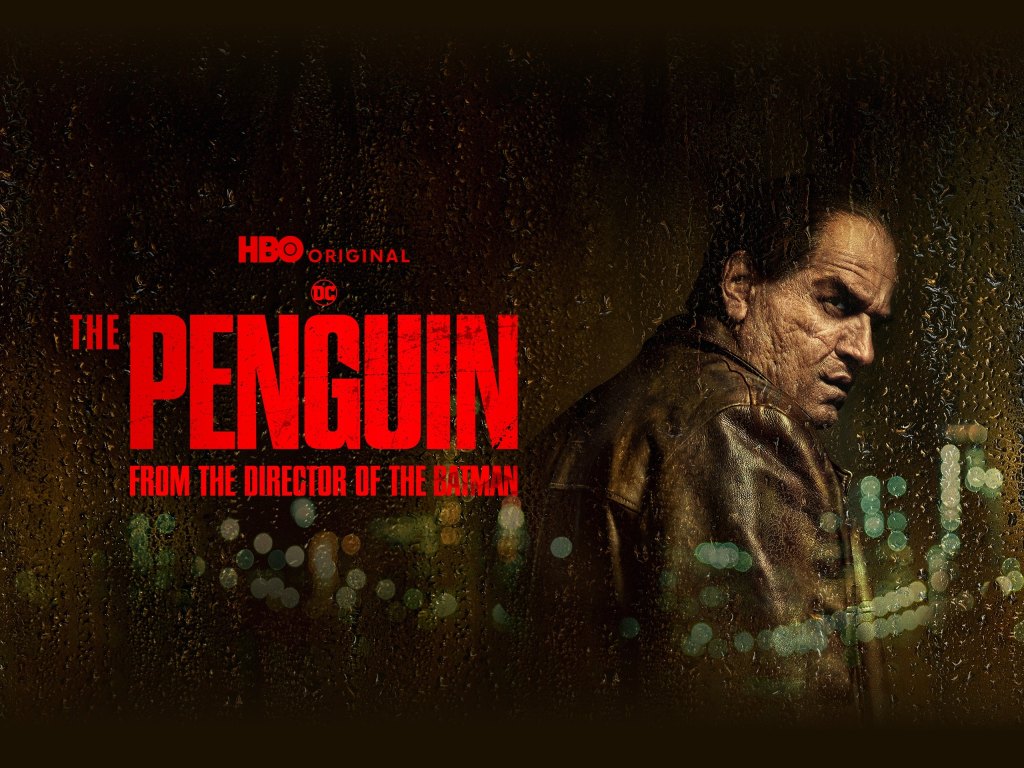
Looking for something fresh to dive into, I headed over to HBO Max, hoping to find something new and intriguing. Scrolling through the options,The Penguin immediately caught my eye. With a dark, gritty thumbnail showing the Penguin in slicked-back hair, a black coat, and an intense, Sopranos-style vibe, it felt like a deliberate nod to the classic anti-hero setup. I figured it might just be the next show worth diving into.
Now, full disclosure-I’m not exactly what you’d call a DC superfan. If anything, I lean toward the Marvel universe, and even within DC, I’m more of a Superman guy than a Batman fan. As for Batman’s rogues’ gallery, well, I tend to gravitate more toward the Joker than the Penguin. So, in all honesty, The Penguin had a bit of an uphill battle to pique my interest. Plus, like many people, I’m starting to feel a bit of superhero fatigue. But the image of Colin Farrell’s Penguin looking straight out of a mob drama, combined with that TV-MA rating, convinced me to give it a shot anyway.
Thinking back to my limited exposure to Batman over the years, it’s mostly the 90s animated series-which I watched more out of lack of options than genuine interest-and the classic Batman movies from the same era, with a vague memory of Danny DeVito’s Penguin and his grimy, fish-eating performance in Batman Returns. I never really dug deeply into the lore. Curious, I took a few moments to dig into the backstory of the show. Turns out, The Penguin is a spin-off of The Batman (2022), a film that’s honestly slipped my mind since its release. Matt Reeves, who directed The Batman, conceived this series to build out the grittier, more complex world of Gotham. And, instead of focusing on more straightforward crime-fighting, this series aims to show us the rise of Oswald Cobblepot-AKA the Penguin-within Gotham’s criminal landscape.
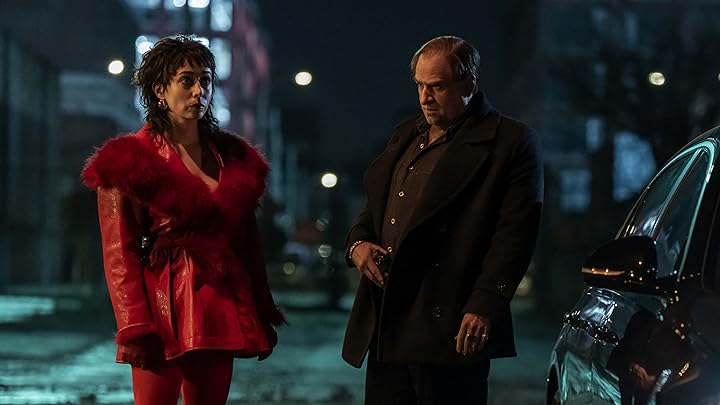
Despite being taken by Sofia, it doesn’t take long for Oz to escape her clutches, but it’s not an easy or safe escape. Under the pain of mutilation, Sofia begs Oz to confess to the murder of his two brothers in front of his mother; something she already knows of and was in denial of for so many years but was brought back to life due to the EMG therapy performed by Rush. But even in the face of the horrible pain about to befall his own mother, someone he says he’d do anything for, Oz continues to lie so bluntly and easily. Sofia is baffled as Oz states that his mother’s disease is once again confusing her and that she has no idea what she’s saying. But in her rage, Frances stabs her son and immediately has a stroke. Oz, in his rage, breaks free and escapes and brings her to the hospital.
Sofia puts out the word to the other crime bosses that Gotham is the prize for bringing Oz to her, but with the help of Vic, all of the old bosses are assassinated and the underlings step into the space left behind, all pledging loyalty to Oz and not Sofia. In a bid to secure power from the government, Oz arranges for the arrest of Sofia, who becomes a scapegoat for everything that’s happened this season. The play is one of those career-making plays and Oz is seemingly well rewarded for his role in the narrative. Meanwhile, Sofia finds herself back in Arkham, but also finds hope and a new familial connection with Selina Kyle (Zoë Kravitz in The Batman) reaching out to her half-sister.
But there are loose ends and in a tragic twist, Oz ends up killing Vic due to the fact that he’s seen far too much of his personal and vulnerable side. Oz decides he can’t have that information about him out in the open to be used against him, even as Vic states Oz his like family to him, and opts to strangle him, despite all the work Vic has done for Oz at the cost of his own humanity. I’ll say this for The Penguin; it really made me loathe Oz and I can’t wait for vengeance justice to claim him. And that’s my main issue with The Penguin. This is about the rise of a criminal, not the fall. Shows like The Sopranos, to which this show so clearly feels inspired by at times, or Breaking Bad, had a great balance between showcasing the crime as well as the human element. I don’t think The Penguin succeeded in that, as Oz is a horrible person with no redeeming qualities. In the aforementioned shows, we got sucked into the tragedy of it all because of family values and seeing a softer side to these characters hiding in the darkness. Oz didn’t have that; if anything he got even more evil as the show went on, and I was wondering why do I even care about him? I want him to fail, which makes for an odd viewing experience seeing him get rewarded for his crimes. Breaking Bad and Sopranos knew when to make their leading men suffer and we still hated them, but we had an understanding of why they were doing what they were doing. Oz is a rat who does criminal things purely for selfish reasons. His concept of family is delusional, which makes it not genuine.
On the flip side, Sofia’s arc was much more believable and engaging because she came from a place of oppression and hardship, she was pawned off to Arkham by her own father and her confident was complicit in this internment. Sofia loathes her family and has motivations for doing what she’s doing, so much so that we’re on board despite the madness and violence she’s inflicting all around her. Her ending the series back in Arkham felt tragic, in its own weird way, because the more interesting character lost in the end and was thus relegated back to the one place she never wanted to return to again. Because Sofia was wronged so intensely, we sympathize with her madness, yet Oz continued to be the personification of scum. Walter White was scum as well, but the table turned on him the more evil he got; Oz is rewarded for his crimes. I get that this is a bridge between the two Batman movies and we needed to see Oz rise to become a viable threat, but I can’t help but wonder that said if Sofia should’ve been the protagonist of this series and the title switched to something else (I’d suggest Gotham, but there’s already a show under that title, so alas).
The series concludes with a time jump and a much more affluent Oz operating out of a glitzy tower, complete with comic book accurate tophat. It’s here where we learn that Oz has gone full Norman Bates, keeping his vegetative mother locked away in his tower as she gazes out at the Gotham skyline, unable to communicate beyond the tears of sorrow she feels. Eve comes back to Oz, perhaps lured by the money he’s making now that he’s “the boss”, and roleplays as his mother for him, saying all the things that Francis is unable to say to Oz, such as how proud she is of him for taking over Gotham. The whole scene I was wondering, will it end with the Bat Signal and sure enough, with a pan and a zoom-out as the show closes out, the sign turns on over the city of Gotham, which is hopefully a threat on Oz’s well-being.
The Penguin was a tour de force when it comes to writing and acting. I’m sure both Colin Farrell and Cristin Milioti will both be serious contenders at next year’s Emmy ceremony and rightfully so. Despite not really being a fan of Oz as a character and seeing his consequence-free rise, Farrell was great (as was Ryder Allen as the younger version of the character). If there’s any reason to watch this show, it’s for the acting and writing. Was it the best show of the year? No, but it was still a great series and episode four was one hell of an episode, standing as one of the best episodes of TV this year.
Guy Ritchie’s “The Gentlemen” is a stylish and witty crime caper that follows American drug lord Mickey Pearson as he attempts to sell off his lucrative marijuana empire to a wealthy Oklahoma family. The film boasts sharp dialogue, a stellar cast, and a visually striking aesthetic, making it a captivating and entertaining ride. While primarily an action-comedy, “The Gentlemen” also explores themes of ambition, loyalty, and the corrupting influence of power, offering a satirical look at the world of organized crime.
To be fair, “The Gentlemen” isn’t a complete disaster as much as a stumle —there are some fun supporting performances and clever sequences, but they’re surrounded by scenes that just feel way too long, as if you can sense Ritchie and his team treading water before they can get back to the fun stuff. The episodic nature of the show sometimes works in its favor because it allows those kind of quick, Ritchie-esque creative choices, but the overall season-long narrative sags and drags in a way that makes it difficult to care about what happens to anyone involved.
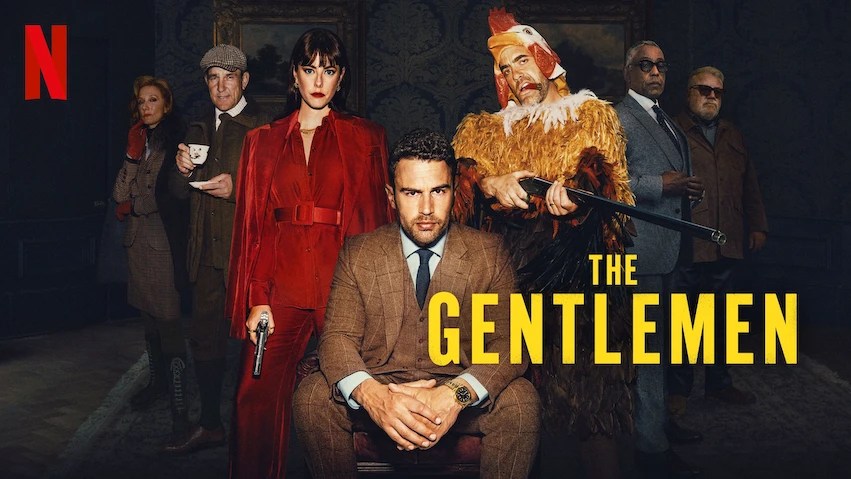
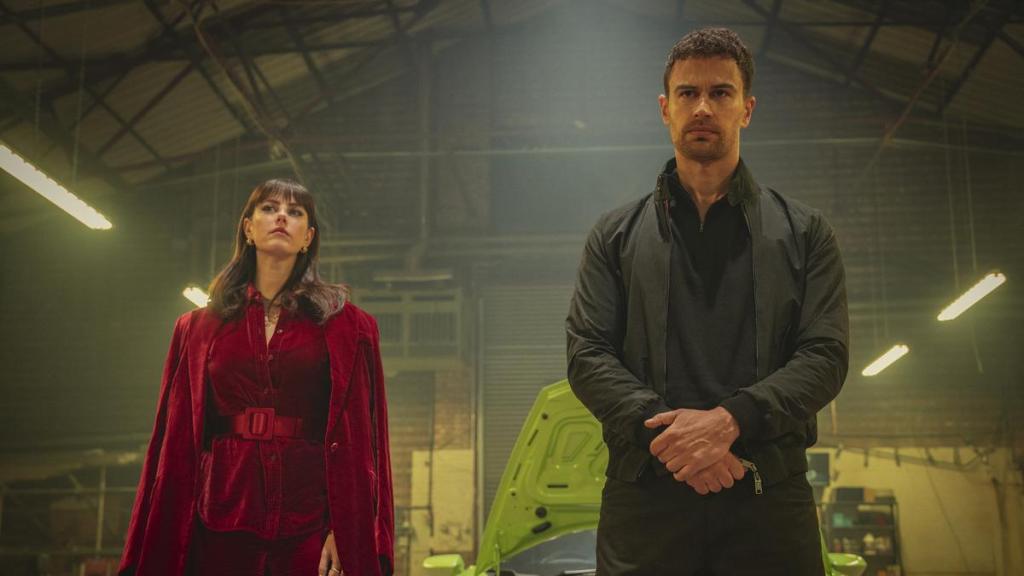
Eddie Horniman (Theo James) plays a suave gentleman who gets sucked into a criminal empire that he’s consistently trying to avoid. When his wealthy father passes away, Eddie discovers that dad had a few cohorts who operated on the other side of the law, which quickly results in the heir having to help manage various criminal operations out of the massive Horniman estate. It actually starts when Eddie’s dumb brother (Daniel Ings) struggles to pay back a boatload of cash to some drug dealers, leading to an extended scene in the premiere in which he dresses like a chicken for maximum embarrassment. Where this scene will end is obvious to anyone who has seen a Ritchie movie, which is part of the overall problem with “The Gentlemen” in that it’s clear that every negotiation is going to go poorly, there will likely be some highly-edited hand-to-hand combat, and probably a needle drop or two. The playbook is too familiar.
f you’re wondering when Matthew McConaughey and Hugh Grant are going to show up, be warned that this is not that show of your dreams. This is a spin-off really in tone and theme only, capturing the world of wealthy criminals in the U.K. and dropping an occasional reference to the film without being directly related to it. It’s a spiritual sibling, another tale of aristocrats who happen to operate criminal empires under the pomp and circumstance. It also has a bunch of Ritchie style to tie it to the film, including scribbled captions that further detail the criminal happenings or overwritten dialogue.
The truth is it’s hard to try and be the coolest cat in the room for eight hours. Eddie himself gets particularly lost in the action, partly due to an underwritten role but also a flat performance from James that creates a black hole at the center of the show. Kaya Scodelario fares much better as the co-lead, the woman who basically serves as Eddie’s liaison to the criminal world, and who gets her own rich arc in the back half of the season. When the show threatens to fall apart, she often brings it back, giving a confident, nuanced performance.
By the end of the season, when Eddie has finally realized what the show made clear all along—that he’s pretty good at this criminal empire thing—viewers will be asking themselves if what unfolded over the previous eight hours wouldn’t have just worked better as a traditional film sequel or spin-off. Eddie may learn that he fits in his new home. Too bad the show about him never really does.
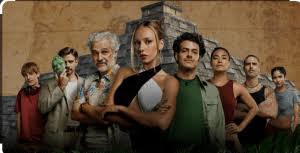
When one thinks of heist comedy, everyone only has the Ocean’s series by Steven Soderbergh to turn to. This was followed by MoneyHeist, which was not a comedy as such but a full-fledged drama that received cult status in no time upon its release. Following in its footsteps, Bandidos, the brand-new Mexican NetflixOriginal, is all about a bunch of misfits who are thieves by profession and want to carry out a heist that could turn out to be one of the best experiences of their lives. Created by Pablo Tébar and directed by Adrian Gunberg, the show was released on March 13, 2024.
This show had a lot about it that I actually did not like, so I want to make that very clear. Some old-fashioned things, like the way they made the two women pinned against each other, made certain sexual things that, to me, were unnecessary and did not add to the plot or anything they had from Cameran. And I was like, ‘OK, we get it, the male gaze.’ There were certain jokes over inappropriate things, and they were saying things I was just like, ‘This?’ But the main plot was pretty good; I have to be honest. So basically, the whole idea is that there’s this main guy; he is the son of a famous archaeologist, and most of his life he’s kind of just been a thief. You find out that his dad is having memory loss and getting older and not really remembering things, so his son, who is a thief and has been really stealing a lot with his uncle, pays for the medical care that his dad needs, and he’s trying to take care of himself. He was, like, money; he got a lot of bad history. His girlfriend is a thief who has a dark past, and you kind of see basically what happens. So from here, he basically finds out about this main treasure that his dad has been looking for for a long time, and his arch enemy nemesis, which is his dad’s old, I guess you can say, rival, who’s older, like each other, and they both are after the treasure. And you get to see how he reconnects with his old girlfriend with the help of this rich son, who basically wants to be known more as an heir, and he helps him steal just to kind of make his own money, which is kind of funny. This other girl who is a good swimmer but also just a little thief, but she has made talent to help them, and then obviously his uncle, and you got to see how they team up together to find this main kind of to get the money and depart way, and you get connections and fun things that happen. So overall, I would say I did like the story. I just had to wonder ahead of time about those things that I was like, I did fast-forward, and I was really like, very, or certain things I was like, this unnecessary didn’t answer the plot, but overall did like it, and I hope there’s a season two.
This immaculately made, supremely witty post-apocalyptic drama is yet another brilliant video game adaptation. It’s funny, self-aware and tense – an astonishing balancing act
The first thing to note is that, as with The Last of Us, there is no need for any viewer to be au fait with the source material of Fallout, Amazon’s new competitor in the field of hit video game adaptations (though a fan of the game who watched it with me assures me that there is much to enjoy in addition to the basic narrative if you are).
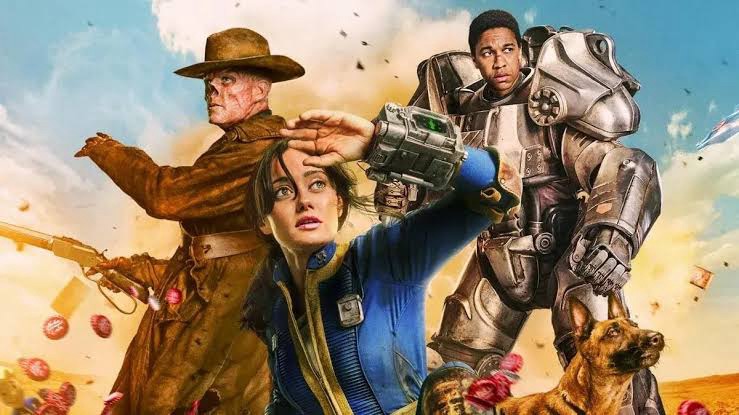
For newcomers such as me, this intelligent, drily witty, immaculately constructed series set in the Fallout universe fully captivates and entertains on its own terms. It opens in 1950s America, at the height of the cold war and the “red scare”, with former TV star Cooper Howard (Walton Goggins) reduced to appearing at a children’s birthday party after being tarred with the pinko brush. A mushroom cloud appears on the horizon, the blast wave hits, the apocalypse arrives.
All those who can afford it rush to the secure vaults they have had built in preparation. We cut to Vault 33 two centuries later, by which point they appear to be doing very nicely. All the naivety of the 50s and the better parts of its mores – politeness, consideration, cooperation, modesty and restraint – have been preserved, albeit with the occasional twist. Like daily weapons training, and chipper approaches to the avoidance of marrying one of your many cousins.
The underground idyll is shattered when they are brutally raided by surface dwellers led by a woman called Moldaver (Sarita Choudhury). Vault Overseer Hank MacLean (Kyle MacLachlan) is kidnapped and his daughter Lucy (Ella Purnell) defies orders from the remaining Council and leaves the Vault to find him. As a wide-eyed believer in the Golden Rule (do unto others as you would have them do unto you), she is wildly unprepared for the array of delights surface-dwelling holds. It’s not like she can disguise herself effectively either. As one gnarled resident of the desperate nearby town of Filly says – “Clean hair, good teeth, all 10 fingers. Must be nice.”
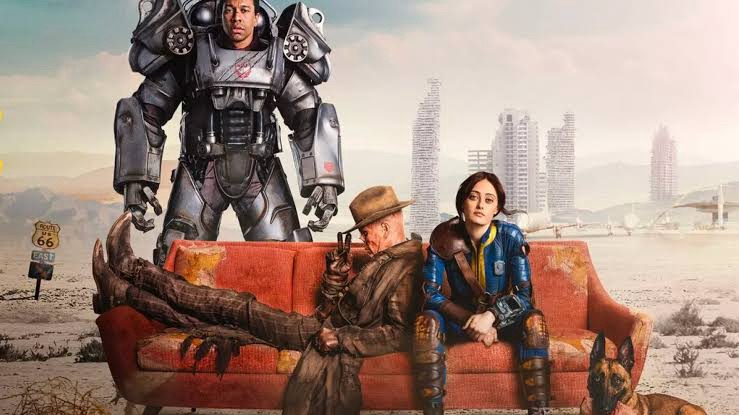
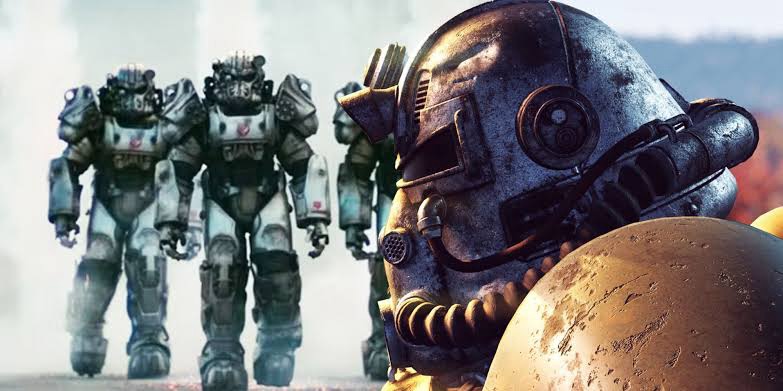
Surface threats include, but are not limited to: giant cockroaches, godawful sea monsters (the Gulper’s innards haunt my dreams), radiation poisoning, strung-out survivors, fanatics of various kinds, puppy incinerators and cannibalistic Fiends. The Brotherhood of Steel try to control the Wasteland but you can’t help but feel, committed warrior faction though they are, that they are on a losing wicket. The Brotherhood is divided into Lords (in battered Iron Man-esque suits), Squires who attend and hope to become them and Aspirants training as Squires. Aspirant Maximus (Aaron Moten) is our guy and we follow him as he rises from bullied victim to rogue Lord. His mission? Acquire the severed head that Lucy also needs to find, containing a chip that Moldaver wants (and which Lucy hopes to trade for Daddy MacLean).
The biggest threat of all, however, is the Ghouls, and one in particular – a noseless, mutated remnant of Cooper Howard who is also hunting for the head and the bounty on it. He is the first to cross paths with Lucy, and oh the fun we have! By the end of a fishing trip, she’s in such a state that if she were to return to Filly, they would probably accept her unquestioningly as one of their own.
Co-creators Geneva Robertson-Dworet and Graham Wagner somehow manage to combine traditional post-nuclear apocalypse tropes with semi-ironic takes on 50s motifs, B-movie conventions and horror-level blood and gore (and work in plenty of Easter eggs and other pleasures for gamers). It’s a perfectly paced story that is both funny and self-aware without winking at the camera, undercutting our increasing emotional investment in characters who reveal – and sometimes unexpectedly redeem – themselves layer by layer. If I tell you that the organ-harvesting robot is voiced by Matt Berry, that the Ghoul’s meeting with a long-lost, rotting colleague almost made me cry and that neither element jarred with the other, perhaps that will convey something of the triumphant balancing act that is maintained throughout the eight-episode series.
It is, if you’ll pardon the pun, an absolute blast. Goggins is wonderful as both the unsullied golden boy Cooper and the wretched Ghoul, Moten brings such nuance to what could easily be a one-note role and Purnell performs Lucy’s fall from innocence brilliantly. The growing mystery back at Vault 32, as Lucy’s brother Norm (Moises Arias) becomes suspicious of the origins of the murderous raid and the supposedly benign Council that has protected them all these years, adds yet another strand to the story and ratchets up the tension even further. In short, for Fallout, I’m all in.
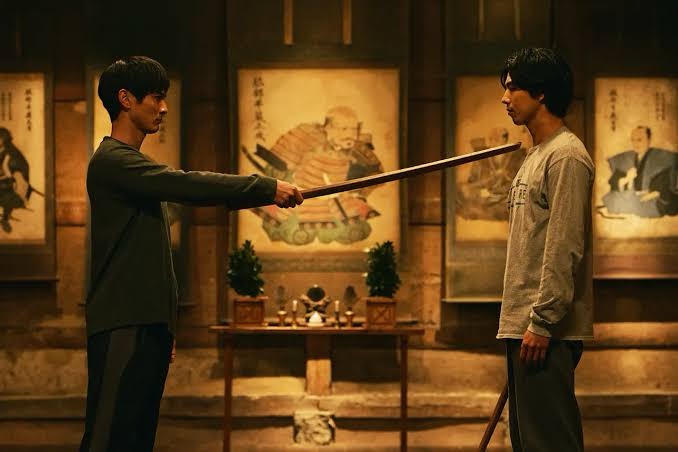
The Netflix series House of Ninjas is a fun throwback to the ninja-sploitation craze of the video rental era, when most Blockbuster and Hollywood Video stores had an entire section devoted to sword-wielding, kung-fu assassins who skulk around at night wearing footie pajamas and masks. Thankfully, in doing so, the show maintains a generally light and playful tone, and doesn’t try to put too much of a dark or revisionist modern spin the material.
Despite being filmed in Japan with a Japanese cast speaking entirely Japanese dialogue, the series is actually the creation of American filmmaker Dave Boyle, known primarily for the 2014 thriller Man from Reno. While Boyle takes a respectful approach toward the subject and the culture, his influences seem to be heavily biased toward B-movies and comic books, and I have to wonder if the show plays differently for an actual Japanese audience than it does for a gaijin like me.
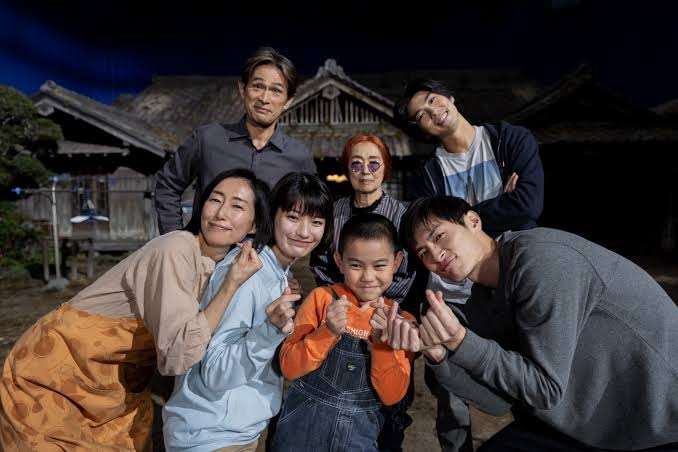
The story centers on the Tawara family, on the surface a seemingly average middle-class household faced with the sort of everyday problems most people can relate to – rebellious kids, relationship issues, parents struggling to keep their business afloat, and so forth. However, unbeknownst to all but a select few, the Tawaras are also secretly a clan of crime-fighting ninjas – or, to use the proper term, shinobi – descended from the legendary Hattori Hanzō, who operate in the shadows to defend Japan from specialized threats that traditional law enforcement cannot handle. If they do their jobs well, no one should ever know they exist or that anything happened. As far as the general public is aware, ninjas died out centuries ago.
Six years earlier, eldest son Gaku was killed during a mission to rescue a politician kidnapped by evil ninjas from the rival Fuma Clan. The family has yet to fully recover from that loss. Surviving son Haru (Kento Kaku) feels not only that he needs to fill his brother’s shoes, but that he may have been responsible for Gaku’s death. Without the others knowing, teenage sister Nagi (Aju Makita) has been acting out by posing as a bandit called the “Rob-and-Return Thief,” stealing historical artifacts from museums only to replace them a few days later right under the noses of police watching for her. Meanwhile, father Souichi (Yôsuke Eguchi) wants the whole family to retire from ninja heroics, but mother Yoko (Tae Kimura) may not be on board with that plan.
When a boat is discovered full of dead bodies all poisoned by a mysterious neurotoxin, connections lead Haru to investigate a shady religious cult, which quickly points to the return of the Fuma Clan with a new evil plot to terrorize Japan. Foiling that will require the family to overcome their petty dysfunctions and personal squabbles to suit up, fight together just like old times, and save the country.
With plenty of death, murder, violence, and occasional heavy themes including loss and grief, House of Ninjas isn’t exactly a comedy. Nevertheless, the show is rarely burdened by the sort of ultra-grim and morose tone that characterizes so much prestige TV in the modern age. Right from the silly title, the show doesn’t take itself entirely seriously. If not based on an actual comic book, the series adopts the flavor of one, with goofy concepts including the existence of a government-run Bureau of Ninja Management that oversees the secret war between good ninjas and bad ninjas in Japan. Episodes also frequently include a number of broad comedic elements, such as the Tawara family’s grandmother kicking ass as an elderly ninja, or the Bureau’s over-the-top dorky IT guy.
Not all of the storylines over the course of the first season work. Grumpy dad Souichi’s insistence on focusing on the family’s brewery business is kind of a drag, and a long plot thread where he believes his wife is cheating on him (when she’s really doing secret spy stuff without him) even though he’s eager to have an emotional affair with another woman, is a bunch of dumb filler nonsense that should have been cut. Most episodes are also fairly light on the ninja fighting action, and I wish there were more of it. Regardless, the eight-episode season goes down quickly. House of Ninjas functions great as a breezy and entertaining palate cleanser between weightier shows. That sort of thing has value.
The Bottom Line : Only sometimes ignites, but the premise is a blast.
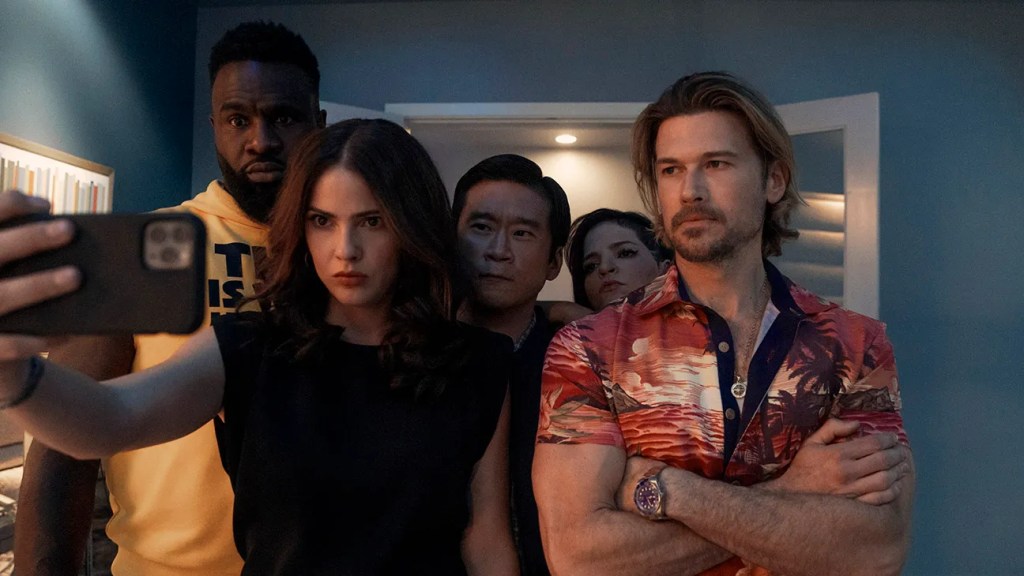
The Series is a blast with Action-Comedy ,Obliterated is brought to you by a writing team with a trio best known for Cobra Kai: Josh Heald, Jon Hurwitz, and Hayden Schlossberg. Here, they bring us another Netflix series that attempts to balance comedy, character drama, and action. An elite team must stop a group of terrorists from blowing up Las Vegas. After believing they’ve succeeded, they party only to discover, now intoxicated, that the bomb the team disarmed was a fake. They must now work through the night to find the real bomb while under the influence of alcohol and drugs.
The first thing to make clear here is that while these are the same writers as Cobra Kai, the writing is certainly in a different style. There is far more of a focus on comedy, and its style evocative of satire, with many surreal and absurd moments. It saves its drama almost exclusively for short instances of emotion. The comedy reminded me far more of Team America or Archer than the Karate Kid sequel series. There’s also a far more R-rated vibe to everything, with a decent amount of nudity, blood, and cursing. In terms of story, the premise is in the style of 24, with most events occurring in real-time, but as a comedy.
Cleverly, the story opens with the team on a mission to find and disarm the fake bomb, thereby giving us a condensed version of what will be to come in the following seven episodes. A party scene follows the bomb disarming, establishing certain character traits and relationships, and setting up plot threads. It’s an exciting way to draw you into the story and establish the main cast of characters. If you are into the story after the first episode, you’ll like the rest of it. But the real meat of the story begins in the second episode. Only then does the plot start resembling something slightly more original and take a few more unexpected twists. What’s weird is that a flashback shows how the mission began, having already done a decent job introducing the characters, their background, the nature of their relationship with each other, and what they do on the team. The flashback gives us very little new information, and even that isn’t anything we couldn’t have guessed. Thankfully, it’s only a few minutes long. As the intensity of the situation increases, Heald and co.’s writing starts to shine through, as they balance the drama of the team’s position with the comedy of how the characters play off each other. On top of the main plot with the bomb, many side plots and character arcs are woven into this eight-episode adventure which help the audience sympathize with the characters much more.
Speaking of the characters, let’s briefly go over what their deal is. Ava (Shelley Hennig), CIA agent and team leader, is the most professional member of the team, and she tries to encourage the rest of them to act professionally, even in several pretty absurd situations. Chad (Nick Zeno) is the typical off-the-rails soldier who doesn’t care about following the rules. He is kind of a dick and a scoundrel towards other members of the team, but as an experienced marine, he also doesn’t think twice about putting his life on the line. Chad also has a romance with Ava, which goes precisely where you’d expect in an R-rated comedy. Trunk (Terrence Terrell) is a longtime marine friend of Chad’s, who is mainly a comic relief and acts like Chad’s wingman in many scenes. He also has a running gag over the story that causes him to become increasingly frustrated as the story progresses. However, it’s a gag that overstays its welcome, making for somewhat predictable jokes towards the end and a fairly obvious payoff. Helicopter pilot Paul (Eugene Kim) is the most down-to-earth of the main cast. He goes through the most distinct bit of character growth, as he juggles his job with finding out where his daughter is, which works well with the show’s style of comedy. However, a sequence with him partway through the story puts his character’s arc on hold for the sake of a rather clichéd joke that annoyed me so much I had to shut the episode off for a bit. But by the end of his arc, it felt like the most original thing in the narrative. Angela (Paola Lazaro), the sniper, is the least developed of the main cast, acting mainly to motivate other characters to grow. Maya (Kimi Rutledge) is the technology expert and geek of the group — she also lacks self-confidence, admitting many times that she is worthless without a computer to work with. There was potential for some real growth, with her becoming a more critical part of the team later, but she never gets a precise moment to shine or be the one to save the day. Haggerty (C. Thomas Howell) only serves one purpose in the story: He’s the only one who can disarm the bomb. Outside of that, his character is dispensable; he’s unconscious for large parts of the story and partakes in much filler the rest of the time.
There are many other characters the group crosses paths with, along with the central team. The story structure is similar to It’s a Mad, Mad, Mad, Mad World,with a large cast of characters splitting off into smaller groups and crossing over occasionally. With this kind of ensemble cast, and multiple storylines going on simultaneously, there is often the danger of the plot becoming overly convoluted and challenging to keep track of. However, it always feels clear where any character is, why they are there, and their relationship with the people they are with.
These performances are solid as well. Since the main cast all play fairly standard archetypes for this kind of story, the show needed some compelling performances to give the whole experience more of a kick. I particularly enjoyed Terrell, as he switches between acting intimidating and acting frustrated by his situation. Kim is another fun performance, because his character may be the straightest of the group, but he has to react to some of the most bizarre circumstances. He sells it with his reactions being precisely the same as the audience’s. Alyson Gorske as the civilian, Lana, is the standout performance for me; something about her presence adds a bit of extra comedy.
The narrative is paper thin, though, as the basic plot is very straightforward: There’s a bomb, and they must stop it from going off. We get a bit of background about who the bad guys’s identities and motives, but nothing that’s required to understand the plot. The story has a few twists, but they’re the surface-level kind you see in every action-adventure story. On top of that, the bad guys are pretty forgettable. The real draw of this show doesn’t come from a deep, slowly thickening plot; it comes from enjoying the ride of the action mixed with comedy.
In particular, the comedy is very hit-or-miss, and a lot of it goes over many standard comedy tropes. To give a few examples: A character thinks they’ve found something but haven’t, characters misunderstand the situation and make things worse, and there are even a few fake-out moments. There’s also some gross-out humor, which I’ve never understood the appeal of, since the whole joke seems to be just that it’s gross. Seeing something disgusting doesn’t make me laugh. However, there is less humor in this series than I thought there would be, and many of the short one-liners or quick moments of humor work. I didn’t laugh out loud that much, mainly because the gags are so rapid-fire that I had no time to react before something else happened. The humor is about the quantity of funny stuff happening, rather than the quality of it.
I’d use the word “quantity” to describe the action in this series and the ‘quality’ of the series. It’s like every action flick rolled into one, and it plays all the hits: gun fights, hand-to-hand combat, sniper situations, car chases, and so forth. Large parts are challenging to see, since over half of the story occurs at night. But outside of that, the way the show is shot is beautifully compelling, and it does a great job utilizing the unique visuals of Las Vegas. Does any specific sequence stand out from any other action flick in the last 30 years? Not at all. But as a whole, it does stand out, since there’s so much of it, and it’s all remarkably entertaining to watch.
Overall, Obliterated is certainly isn’t in the same league as its writing team’s other Netflix series. It is, however, a lot of fun, and has a straightforward plot that makes it easy to follow and not take too seriously, despite the high stakes of the premise. Something new happens in every scene, and there’s a great mix of action and comedy that always feels like it is giving us the right amount of one or the other. The tone sometimes feels slightly messy, especially during significant conflict between the characters. Many of the jokes and a few plot twists are predictable and cliche. The characters are the driving force of what makes this a profoundly compelling experience. Like a night out in Las Vegas, don’t think too hard; just enjoy yourself had lot of fun watching it.
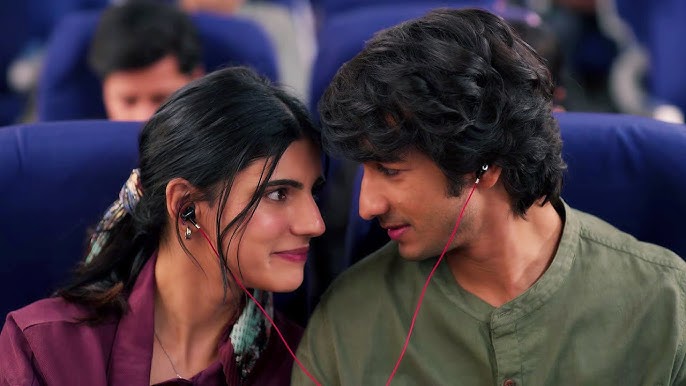
Romantic , feel good series depict the story of two poles that meet, but Ishq in the Air creates an entirely new plot from the usual storyline. In its simplest sense, it depicts the true theme of love amidst two different worlds of the characters Kavya and Naman. This lovely romantic melodrama captures the feelings of how a spontaneous attachment can happen in the most inopportune of times, such as when one is stuck on an aeroplane.
The plot centers around Naman (played by Shantanu Maheshwari), a shy young man from Indore, who is boarding a flight to Mumbai for the first time. Fate brings him together with Kavya (Medha Rana), a confident hairstylist from Mumbai. Their personalities couldn’t be more different, but when their flight is delayed, the two get to spend some time together. This sets the stage for a love story that evolves over time. Where this love story leads, you’ll have to watch and find out. The storyline is simple, yet it strikes a chord, making you think about your own romantic memories.
The charm of ‘ Ishq in the Air’ lies in its simplicity. You’ll find a lot of Naman-like characters around you. Similarly, Kavya represents many modern-day women, balancing ambition with emotion. The beauty of this series is that it doesn’t try too hard to impress. It shows life as it is—without unnecessary exaggeration. While it captures the vibe of modern urban life, it also touches on the simplicity of small-town living. Consisting of five episodes, each about 35 minutes long, the series keeps a steady pace without dragging. It’s a light watch, and the relatability factor makes it enjoyable, reminding us of the universal feeling of love.
Shantanu Maheshwari shines in his role. He captures Naman’s innocence with perfection, portraying the nervousness of a first-time flyer or the awkwardness of holding a girl’s hand for the first time. His expressions—from sweating at the touch of a girl to charming his grandmother to win over his parents—are spot on. Maheshwari’s portrayal of Naman is heartwarming and endearing.
Medha Rana also nails her role as Kavya, the confident Mumbai girl who finds herself falling for a boy from a small town. She perfectly captures the balance between her big-city dreams and the affection she develops for Naman’s humble aspirations. Their chemistry is natural and relatable, and together, they win your heart. The supporting cast, too, delivers solid performances, adding to the charm of the series.
‘Ishq in the Air’ is a light-hearted, feel-good, relatable series that will leave you reminiscing about your own love story.
You won’t hear terms like trabajadora sexual – that’s Spanish for “sex worker” – in Netflix’s new series about three trafficked women on the run. If you are familiar with previous series from Álex Pina and Esther Martínez Lobato – including the huge international hit Money Heist (La casa de Papel) and the English-language, Ibiza-set crime caper White Lines – then you can probably guess the tone.Early 2021, Netflix released Sky Rojo, a Spanish action crime drama following three prostitutes, who attempt to flee from their employer but get roped in a frantic and chaotic journey to save themselves from their previous life. Made by the creators of the international hit-series La Casa de Papel, the series shares pulpy similarities with much of Tarantino’s filmography and is described as showing “the impunity, ambiguity and brutal reality of prostitution, and the psychological portraits of those on both sides of the scale.”
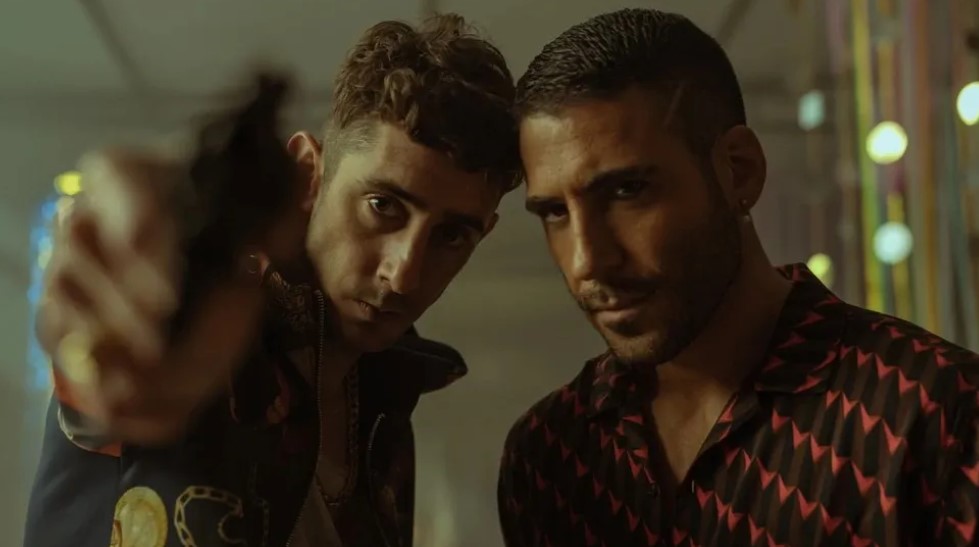
Sky Rojo pursues the stories of Coral (Verónica Sánchez), Wendy (Lali Espósito) and Gina (Yany Prado), three prostitutes working at the Las Novias Club, a strip club and brothel in Tenerife, owned by the sleazy and abusive Romeo (Asier Etxeandia). The series commences with Gina confronting Romeo after his wife’s funeral with a roll of cash she had saved in attempt to pay her debts and leave the club. She is rebuffed by Romeo and when she hits him in anger, Romeo stabs her repeatedly with a pen until Coral and Wendy intervene. After Wendy knocks him out, the girls run away in fear of getting arrested (or worse) as the vengeful Romeo sends his henchmen, Moises (Miguel Ángel Silvestre) and his brother, Christian (Enric Auquer) to bring them back.
The storylines in Sky Rojo focuses on elements of love and friendship, particularly between the three women as they face the dangers of escaping Romeo. It highlights how they are stronger when they work together and the importance of having someone to support you in the making difficult decisions. Despite Sky Rojo’s attempts at presenting a story of women overcoming the worst parts of a patriarchal system, it pans out as faux-feminist and a lackluster attempt at female empowerment. Even as a series fixated on the horrors of human trafficking and forced prostitution, a number of scenes centralize on pandering to the male gaze. There are extensive lingering shots of women being coerced into sexual acts and degraded for the pleasure of the men around them. Even after their escape, Wendy is cornered by a former customer in a restaurant bathroom and violently raped- the whole ordeal is chronicled through her tear-stained face and is painful to watch.
Additionally, Asier Etxeandia’s Romeo is often seen parading the women around the club in little to no clothing and referring to them as objects for male fantasies. The women’s bodies are constantly fetishised, degraded and criticised; in one such scene, a girl with a naturally small chest is forced to get her breasts augmented against her will for the sake of getting more customers- the money from her procedure is later added to her debt to the club. The girls are also shown to be compelled into unwanted group sex where they are repeatedly violated and brutalized by male customers. While some may argue that these scenes are an accurate depiction of what goes on behind the scenes in human trafficking and prostitution, Sky Rojo presents an excessive and graphic amount of sexual violence, almost to a perverse degree. In one particular scene where Romeo’s men are celebrating at his club, an inebriated Christian prevents one of the men from leaving early and viciously sodomizes him in front of everyone, under the pretense of a “joke”. Not only is the scene deeply uncomfortable for the people watching, it is also a subtle reference to how sexual assault against men are often neglected and unrecognized in communities.
In spite of these scenes, the Sky Rojo has no shortage in efforts to humanize sexual offenders. Romeo is perceived as a lonely widower left with two young daughters after his wife’s battle with cancer- her funeral had almost no attendees aside from Romeo’s own employees, indicating how disliked he was in the community. The brothers, Moises and Christian, have their own tragic backstory; Moises is indebted to Romeo after the latter helped get rid of their abusive father and supported them financially when taking care of their ailing mother. Compared to the older and more capable Moises, Christian is insecure and shown to have issues with sobriety and gaining the favor of their mother. Even the man who raped Wendy in the bathroom, is projected to gain sympathy from the audience after he later ends up helping the women steal from Romeo. Such moments seem to enable the audience to pardon their actions and perceive them as “mistakes” after character development- furthering society’s very real tendency to forgive sexual offenders and dismiss their offenses as “lapses in judgement” while dispelling the lifetime of trauma experienced by survivors.
Regardless of the problematic content, Sky Rojo continues as a deeply thrilling watch. With fast-paced cinematography embellished with visuals akin to 90’s pop music videos, each episode is approximately 30 minutes long and filled to the brim with unpredictable twists and turns. Coral, Wendy and Gina face several challenges during their escape, from gunshot wounds to being secretly tracked, and in the face of danger, their solutions are both quick-witted and borderline comedic. Even with freedom so easily in their grasp, these characters do not fail to consider the moral quandaries of their actions. For instance, when they find an injured man in their getaway vehicle, the women are waylaid by their decision to get him medical attention despite Romeo closing in on them. Similarly, though the women get multiple opportunities to eliminate Romeo and their adversaries, they choose to save themselves through the least violent solution. These moments further contribute to the women’s characters, allowing the audience to develop a rapport with them while also rooting for them.
With excellent performances and electrifying plotlines, Sky Rojo is no doubt one of the most impressive shows in Netflix’s repertoire. The punchy cliffhangers coupled with the inhuman realities in prostitution and human trafficking, enable the audience to experience varying emotional frequencies while acclimating themselves to the foreign silver screen outside of traditional Hollywood series. Nevertheless, Sky Rojo is constantly balancing on a tightrope between empowering women and exploiting them, and thus, fails to call emphasis on the points on female friendship and sisterhood that the series attempts to fasten itself to.
&et in the aftermath of the 1993 Bombay blasts, this crime drama focuses on DCP Samarth Kaushik, a kidnapping and encounter specialist who has solved several tough cases. The investigation begins when the kidnapping of a hotelier, the mysterious murder of an investigative officer and the case of a journalist being stalked are found to have one thing in common – Kathmandu. This sends DCP Samarth on a chase to Nepal, while journalist Shivani Bhatnagar, deals with her mystery stalker.
A story that grabs your attention The six-part series kickstarts with three interconnected cases that may be linked to the 1993 Bombay blasts. Sandip Garg, an investigating officer in the blasts is found murdered on March 25, in the same year. Meanwhile, hotelier Dharmendra Arora is kidnapped around the same time, while Shivani Bhatnagar (Aksha Pardasany), a famous journalist and news anchor, receives calls from a mysterious man.
DCP Samarth Kaushik (Amit Sial) begins to investigate these three cases and with the help of CBI Officer Hitesh Agrawal (Gopal Dutt), he finds that each of these has something to do with Kathmandu. Along with his partner, he heads to Kathmandu to find out more about an influential smuggler named Mirza Baig (Zakir Hussain), who seems to have something to do with the blasts and the inter-connected cases. DCP Samarth’s arrival in Kathmandu also brings him face-to-face with Sunny Sharma (Anshumaan Pushkar), a con man who claims to have been falsely named as an accused in the ’93 blasts by a gangster wearing dark glasses who doesn’t say much (you know who that is!).
The show promises more than it delivers The first two episodes are intriguing, because characters are still being set up and the story is just getting interesting. Viewers will find themselves invested in the case, not only because it hits home, but also because of Amit Sial. He does justice to the role of a tough cop with a drinking problem. His nuanced performance is what keeps one going.
The show takes time getting to the crux of things. A lot of unnecessary screen-time is devoted to a love angle between Shivani and DCP Samarth, as well as Sunny’s weird obsession with Shivani, which he calls ‘true love’. On the whole, the makers promise a whole lot but deliver a half-baked story. What they do get right is the look of the time. The show is packed with proper ’90s elements, right from the outfits and the makeup to the sets and the cars and ‘Stranger Things’-esque background score.
Creator: Sachin Pathak Cast: Amit Sial, Aksha Pardasany, Anshumaan Pushkar, Gopal Dutt, Zakir Hussain Streaming on: SonyLIV








 Beyond the Cinema's